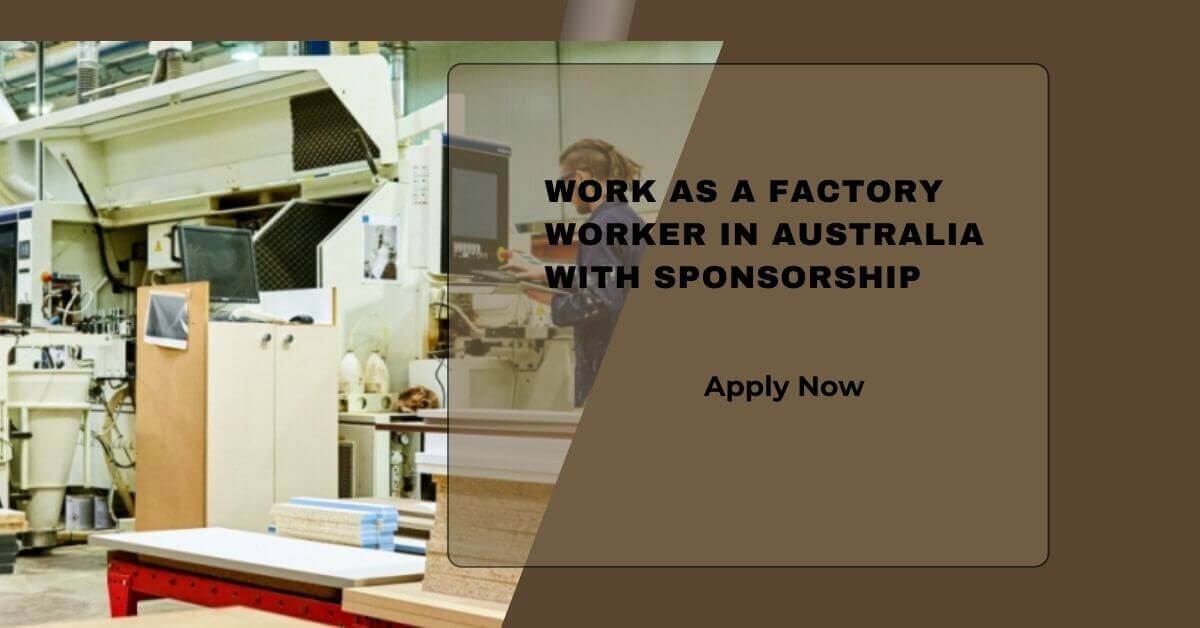
Work As A Factory Worker In Australia with Sponsorship, Australia continues to welcome international applicants for factory worker roles across thriving industries, including food processing (meat, dairy, and produce), textiles, machinery, and packaging. These positions generally involve operating machinery, assembly-line work, quality inspection, packaging, and general operational support. No higher education is required, and many roles provide on-the-job training to develop practical skills.
Employers often sponsor foreign workers through visa pathways such as the Temporary Skill Shortage (TSS) Subclass 482, allowing employment for up to four years, and regional programs like Subclass 494, which include regional Designated Area Migration Agreements (DAMA) in rural zones. These programs enable skilled and motivated international candidates to gain valuable experience in Australia’s manufacturing sector while contributing to local industry growth. Factory workers in Australia typically earn an average annual salary of $59,280, providing a competitive income along with training and career development opportunities.
Details of Work As A Factory Worker In Australia:
- Job Title: Work As A Factory Worker In Australia with Sponsorship
- Job Location: Australia
- Language Required: English
- Who can Apply: All Nationalities
- Visa Sponsorship: Yes
Visa Sponsorship requirements:
- suitable enterprise: accredited by the Australian government to sponsor foreign laborers.
- activity provision: the actual process provided by a sponsoring organization.
- competence evaluation: may be necessary to demonstrate the qualifications for the process.
- Training and painting experience: Comply with distinctive requirements that are solely determined by the visa.
- Proficiency in the English language: demonstrate proficiency by taking the IELTS or TOEFL.
- health and character requirements: Comply with specific physical and personal standards.
- Local areas: a few visas necessitate that the applicant reside and work in a nearby region of Australia.
- Checking the labor market: Additionally, your organization may be required to demonstrate its inability to locate an appropriate Australian employee.
Requirements:
The qualifications and personal characteristics of the individuals selected for those positions are as follows:
- All candidates must possess a valid forklift license.
- It is imperative for expatriates in Australia to adhere to the legal regulations and policies.
- Exhibiting a meticulous attention to detail in every minute detail.
- The ability to adhere to rigorous schedule constraints and punctuality
- capable of performing repetitive guide management duties.
- eager to exert themselves continuously at some point during the entire transition.
- A person who is dependable and unwavering, understands the significance of being punctual, and consistently excels in their work.
- demonstrate a sense of personal satisfaction and achievement, in addition to a diligent and conscientious approach to all responsibilities.
- organized to execute tactics and instructions with meticulous precision.
Responsibilities:
- operate a manufacturing device
- upkeep the warehouse’s machinery
- Collect machinery components
- products and materials that are stored
- For the duration of the shift, adhere to the deadlines for individual manufacturing tasks.
- document regarding defective equipment or merchandise
- examine inventory levels and notify product or raw material deficiencies.
- Maintain a clean worksite to prevent the accumulation of hazardous chemicals and fragile products.
- construe equipment by reviewing and observing manufacturing manuals
- make certain that the delivery methods are punctual
- manually or with transport vehicles
- adhere to the organization’s security protocols and beneficial recommendations
Also Check: Food Factory Worker Jobs Australia
Benefits:
- Access-level opportunities: Frequently, manufacturing facility helper positions are access-stage, allowing individuals with restrained work to revel in or the ones pursuing their first process to use. This will be an incredible stepping stone for the ones looking for work experience and a vocation in production or associated industries.
- Process protection: The producing enterprise is a pillar of the economic system, and manufacturing unit assistant positions are normally in excessive demand. This can provide an experience of task safety, as factories often want a regular body of workers to fulfill production needs.
- Preparation and capacity development: Numerous manufacturing facility assistant positions provide on-the-job coaching to teach personnel unique abilities and processes. This education is beneficial for personal and expert development, as it equips employees with transferable abilties applicable to a range of positions and industries.
- Aggressive profits: commonly, factory helper positions offer competitive pay, especially when compared to different access-degree positions in other industries. As personnel advantage revels in and new abilties, they’ll end up eligible for pay will increase.
- Advantages and Perks: some manufacturing facility positions encompass blessings inclusive of medical insurance, retirement plans, vacation pay, and bonuses. Those advantages can decorate process pleasure and economic stability.
- Career advancement: inside the manufacturing industry, factory assistant roles can function as stepping stones to greater advanced positions. As people gather and revel in and expertise, they will be capable of improving their careers and expect positions with greater duties and higher pay.
- Diverse administrative center settings: There are an expansion of industries that rent manufacturing unit assistants, which include the automotive, electronics, and meals processing industries. This diversity presents people the possibility to explore numerous fields and collect experience with an expansion of production techniques.
- Cooperation and Coordination: In factories, personnel are often required to function as a team to acquire production goals. This promotes collaboration and the growth of interpersonal talents, which can be high quality in any profession.
Salary:
The common annual revenue of a factory worker in Australia is $59,280, which equates to $30.40 per hour. Positions that are access-stage begin at $52,650 yearly, while the majority of skilled employees earn up to $81,350 annually.
How to Apply:
Working in a factory in Australia is an exceptional way for human beings from different international locations to get useful experience inside the manufacturing industry, and they could get their visas paid for too. The task comes with the right pay, the risk to advance in your work, and useful group surroundings.
Step-by-Step Process:
- It is important to consider the use of recruitment groups that specialize in commercial and manufacturing positions. Additionally, manufacturing unit job listings may be available at large corporations.
- establish connections with other expatriates and participate in business events. Furthermore, utilize platforms such as LinkedIn to establish connections with executives in the manufacturing sector.
- Foreign workers can investigate and pursue promising career opportunities in Australia’s vibrant manufacturing sectors with the appropriate education and comprehension.
- Click HERE to use for manufacturing unit worker jobs in Australia
Top Websites to Find Jobs in Australia:
Frequently Asked Questions:
Can I work in an Australian factory with visa sponsorship?
Yes, many factory roles especially in regions facing labor shortages offer employer-sponsored visas for foreign workers. Employers in industries like food processing, manufacturing, packaging, and automotive often sponsor overseas factory workers.
What are the general requirements?
Age: Usually 18–45
Experience: 6–12 months factory or production work helps; unskilled roles may accept minimal experience
English: Basic functional English; IELTS ~4.5–5.0 or equivalent tests.
Health & Character: Medical exams and police clearance certificate are required.
Other: Physical fitness, ability to follow safety protocols, willingness to work shifts, especially in regional areasAre there specific regional migration schemes?
Yes. The DAMA (Designated Area Migration Agreement) allows regional employers to sponsor semi-skilled workers with lower thresholds, including roles like forklift operators and packers. Potential pathway to permanent residency.
Also, the Skilled Employer-Sponsored Regional (Subclass 494) supports work and eventual PR in regional Australia