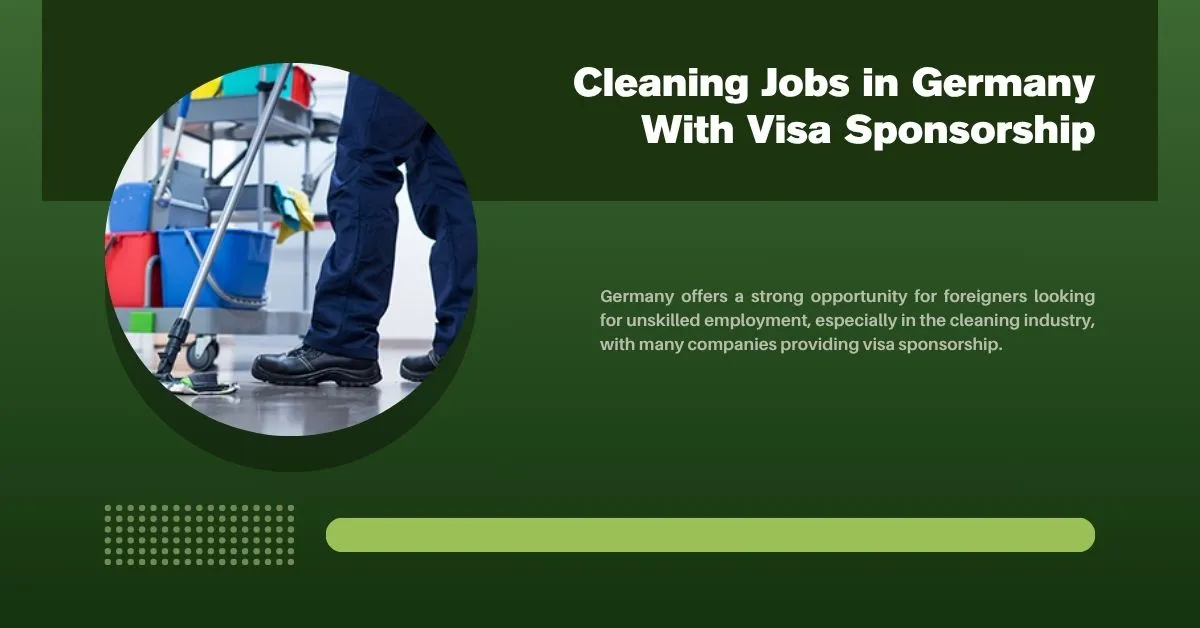
Germany’s robust economy has created a high demand for reliable cleaners, and many companies are now offering full visa sponsorship to international applicants. This isn’t just a job; it’s a secure pathway to legal residency, comprehensive social benefits, and a high quality of life in one of the world’s most prosperous countries.
If you’re ready for honest work and want to know exactly what to expect, you’re in the right place. We’ll break down the realistic average pay of €11.50 per hour, the step-by-step visa process (including the new Opportunity Card), and the extensive benefits like paid vacation and health insurance. Discover how your strong work ethic can be your ticket to a new future in Germany.
Read Also: Housekeeping Jobs in Germany for English Speakers
Details of Cleaning Jobs in Germany With Visa Sponsorship
Key Points
- Country: Germany
- Job Type: Cleaner
- Experience Required: No
- Knowledge Required: No
- Age Limit: Minimum 20 Years
- Visa Sponsorship: Yes (Some companies offer)
Job Description:
Cleaning jobs, sometimes called “Reinigungskraft” occupations in Germany, include a variety of duties like dusting, vacuuming, mopping, and cleaning kitchens and bathrooms in homes and businesses. These jobs can be performed during the day or at night and can be either part-time or full-time.
Benefits of Cleaning Jobs in Germany:
1. Visa Sponsorship
- In order to help foreign workers get legal employment and residency status, Germany has a large number of respectable cleaning firms and facility management services that sponsor visas.
- Support for integration, relocation, and work permit applications are all included with sponsorship.
2. Health Insurance
- Because they are covered by Germany’s statutory health insurance program, employees have full access to medical treatment, including prescription drugs, hospital stays, and doctor visits.
3. Paid Time Off
- Employees are entitled to 20–30 days of paid vacation time per year.
- Medical certification also entitles one to paid sick leave.
4. Overtime Pay
- Overtime pay, which is usually computed at 25–100% extra per hour depending on the employer and employment agreement, is frequently given for work beyond the regular hours.
5. Pension Contributions
- Employers assist employees in accumulating retirement funds over time by making contributions to the German pension insurance program.
6. Performance Bonuses
- Some companies provide financial bonuses based on:
- Work performance
- Punctuality and attendance
- Overall company profits
7. On-the-Job Training
- Cleaning personnel are frequently trained in safety, equipment operation, and hygienic standards.
- Possibilities for professional progression and skill improvement (e.g., managerial roles).
8. Work-Life Balance & Legal Protection
- Germany enforces strict labor laws, ensuring:
- Limited working hours
- Legal contracts
- Job security
- Worker protections under the law
Requirements For Cleaning Jobs in Germany:
1. Valid Job Offer from a German Employer
- The first step is to obtain a job offer from a German company that is authorized to sponsor your work visa.
- Particularly for non-EU applicants, the business must demonstrate that no local or EU candidate can fill the position.
2. Work Visa (German Employment Visa)
- The German Employment Visa, which falls under the categories of skilled or low-skilled workers, is the most popular path.
- authorized by the Federal Employment Agency (BA, Bundesagentur für Arbeit) and sponsored by the employer.
3. Required Documents
To apply for the visa, you will typically need:
- Valid passport (with at least 6–12 months validity)
- signed offer letter or employment contract
- Evidence of accommodations in Germany (which the employer may arrange)
- CV, or curriculum vitae
- Valid health insurance coverage in Germany
- Motivational letter outlining the reason for the stay
- Certificate of clean criminal history
- Certificate of medical fitness
- Application for a visa and evidence of payment
4. Educational or Work Experience
- For the majority of cleaning occupations, no formal schooling is necessary.
- While not required, basic cleaning or facility maintenance work experience is preferred.
- It is advantageous to have prior knowledge of cleaning supplies, chemicals, and safety protocols.
5. Language Skills
- A1–A2 level basic German is preferable and occasionally necessary.
- Basic English may be accepted for some positions, but German is becoming more and more required for:
- Understanding safety instructions
- Communicating with supervisors and team members
Average Salary:
A cleaner in Germany makes, on average, €11.50 per hour. However, this can change depending on a number of variables, including the cleaning work type, company, experience, and geography.
Visa Requirements:
1. Understanding the Visa Pathways
There are two main routes, and the correct one depends on whether you have formal vocational training:
- For Skilled Workers with Vocational Training: If you have completed a state-recognized vocational training program (e.g., as a Gebäudereiniger/-in, building cleaner) that is at least two years long and is recognized in Germany, you can apply for the skilled worker visa. This is the most common and straightforward path.
- For Non-Skilled Workers (The Opportunity Card): If you do not have formal vocational training, the new Opportunity Card (Chancenkarte) is your primary pathway. It is a points-based system that allows you to come to Germany to seek a job.
2. Key Requirements for the Skilled Worker Visa (for Cleaning Jobs)
This is for applicants who have formal training as a cleaner.
- A. Recognized Vocational Training Certificate: You must have a completed, state-recognized vocational qualification of at least two years that is comparable to a German qualification. Your cleaning qualification may need to be formally recognized in Germany.
- B. A Concrete Job Offer from a German Employer:This is the “sponsorship.” A German company must offer you an employment contract that matches your qualifications.
- C. Equivalence Check: Your vocational training certificate must be reviewed and recognized by the relevant German authority (e.g., IHK FOSA for many trades).
- D. Financial Means: You must prove you can support yourself upon initial arrival until you receive your first salary (unless the contract starts immediately).
- E. Health Insurance: You must have valid German health insurance from the first day of your stay.
- F. Age & Language: You must be over 18 and possess at least basic German language skills (typically A1 level for the visa, but B1 or higher is strongly recommended for daily life and the job market).
Who Can Apply?
People from all over the world, regardless of where they are from, can find work cleaning in Germany. Applications for these opportunities are welcome from foreigners living outside of Germany.
List of Cleaning Jobs in Germany for Foreigners:
- Residential Cleaner: A residential cleaner is in charge of keeping private residences and apartments clean and in good condition. Dusting, vacuuming, mopping, and cleaning kitchens and bathrooms are a few examples of tasks.
- Commercial Cleaners: are in charge of maintaining and cleaning business structures like factories, retail malls, and offices. Dusting, vacuuming, mopping, and bathroom cleaning are a few examples of tasks.
- Industrial Cleaner: An industrial cleaner is in charge of keeping industrial buildings like factories and warehouses clean and in good condition. In addition to using specialized equipment for routine cleaning, duties may involve cleaning machinery and equipment.
- Housekeeper: A housekeeper is in charge of keeping hotels, resorts, and other hospitality facilities clean and in good condition. Among the tasks could be refilling amenities, cleaning restrooms, changing sheets, and making beds.
- Window Cleaner: In charge of keeping windows both inside and outside of buildings clean and in good condition. To clean windows of filth and grime, tasks may require the use of specialist equipment and cleaning agents.
- Kitchen Cleaner: Cleaning and maintaining commercial kitchens, including ovens, is the responsibility of the kitchen cleaner. grills, fryers, and other kitchen equipment. Tasks may also include washing dishes and utensils.
Conclusion:
For foreigners looking for unskilled labor, cleaning jobs in Germany offer accessible, stable, and lawful employment. Germany will still be a popular destination for workers from around the world due to its competitive salary, extensive benefits, including sponsorship of visas, and lack of stringent degree or experience requirements.
These positions are especially appropriate for driven people looking for long-term employment, integration into European society, and professional advancement in a safe and legal workplace
Frequently Asked Questions:
Can I get a cleaning job in Germany with visa sponsorship?
Yes. Many facility management companies and cleaning firms sponsor visas for foreign applicants, especially if they cannot find suitable EU candidates.
Is German language knowledge required?
An A1 to A2 level of basic German is preferable and frequently necessary. Basic English may be accepted for some professions; however, knowing German is helpful.