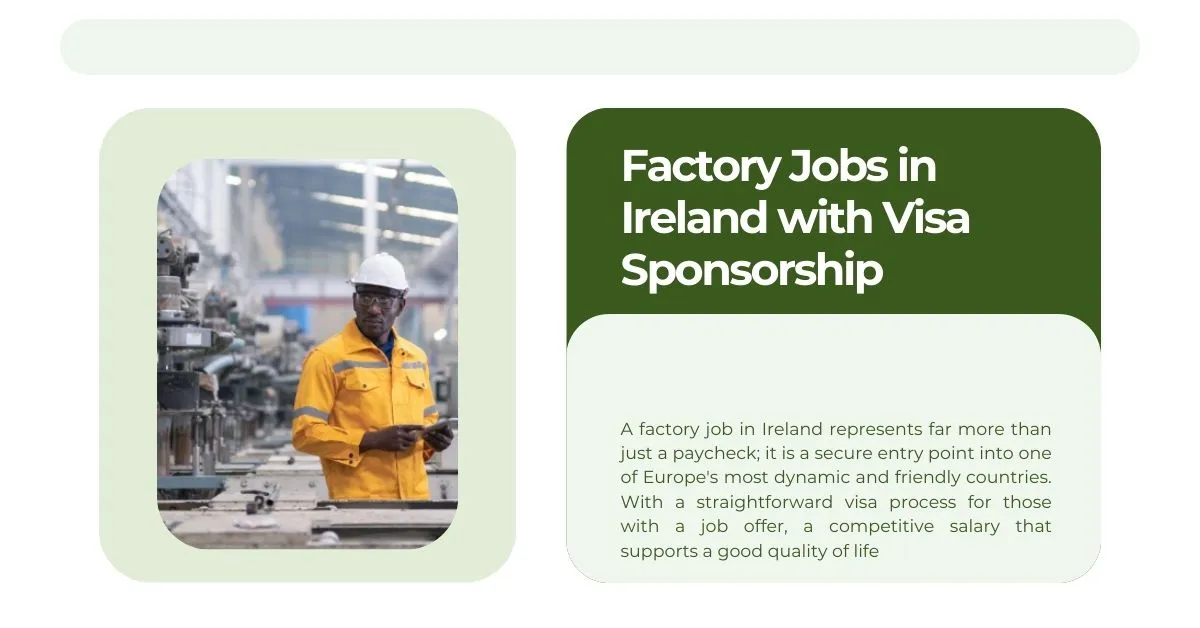
Imagine building a secure future in a country celebrated for its lush landscapes, rich culture, and welcoming communities. Ireland’s robust manufacturing sector is actively seeking dedicated individuals to join its workforce in 2026, offering a reliable pathway for international workers.
If you are looking for a stable career with clear benefits and the opportunity to live in a vibrant European nation, a factory job in Ireland could be your perfect gateway. These essential roles are the engine of Ireland’s economy, providing not just employment but a foundation for a new life, complete with full visa sponsorship.
This is an accessible opportunity for hardworking individuals, with no prior experience required and a competitive hourly wage of €17 (approximately €35,034 per year). Ireland values its workers, ensuring fair treatment, a healthy work-life balance, and a supportive environment for you to thrive.
Details of Factory Job in Ireland:
- Job Title: Factory Jobs in Ireland with Visa Sponsorship
- Country: Ireland
- Job Type: Full-Time / Part-Time
- Qualification Required: High School, Secondary, or Bachelor’s Degree
- Experience: Not Required
- Language Requirement: Basic English
- Age Limit: 21 Years and Above
- Gender: Male / Female
- Who Can Apply: International Applicants
- Visa Sponsorship: Provided
- Salary: €17 per Hour
Work Responsibilities:
- Ensuring High Production Standards: To keep the quality high, make sure that all goods are made to strict standards and meet all requirements.
- Producing Fruit and Vegetable Products: Follow certain rules and directions as you make a variety of fruit and vegetable products.
- Maintaining a Clean and Hygienic Environment: To keep the workplace safe and free of germs, make sure the work area is clean and germ-free and follows all health and safety rules.
- Correctly Filling Out Documents: Carefully fill out all the paperwork that is needed for production, quality control, and safety processes.
- Supporting Production Areas: As needed, help out in different production areas, making sure that everything runs smoothly and efficiently at all steps of the production process.
Benefits of Factory in Ireland:
- Competitive Wages: Ireland provides factory laborers with reasonable compensation, frequently surpassing the national minimum wage. The total compensation bundle is attractive because numerous factories offer bonuses and overtime pay.
- Employment Opportunities: Ireland’s manufacturing sector is multifaceted, encompassing a wide range of industries, including pharmaceuticals, food production, technology, and electronics. This diversity creates a consistent demand for factory workers and expands existing job opportunities.
- Social Security and Benefits: In Ireland, factory workers are entitled to a comprehensive range of social security benefits, such as health insurance, unemployment benefits, pensions, and paid medical leave. These benefits offer long-term financial stability.
- Stable Working Conditions: Irish labor laws guarantee factory workers robust protections, which guarantee secure and wholesome work environments. Additionally, employment security is enhanced by the ability of employees to advocate for their rights and form unions.
- Work-Life Balance: Factory positions in Ireland generally adhere to the standard working week (39 hours), with reasonable working hours and paid holidays. This promotes a healthy work-life balance, allowing for time off to attend to personal and family responsibilities.
- Training and Development: Numerous factories provide on-the-job training, which can assist employees in the acquisition of new skills and the potential for advancement within the organization. This training has the potential to serve as a foundation for more advanced or lucrative positions within the manufacturing industry.
- Job Security: Ireland’s economy is stable, and its industrial foundation is robust, particularly in sectors such as pharmaceuticals, food, and technology manufacturing. These sectors are comparatively recession-resistant, ensuring that factory workers have long-term job security.
- Multicultural Work Environment: The diverse and inclusive work environment in Ireland is a result of the numerous factory positions that attract workers from a variety of nationalities. This is particularly advantageous for foreign workers, who may discover it simpler to assimilate into the workforce.
- Path to Permanent Residency: Factory employment in Ireland can serve as a means for foreign workers to acquire long-term work visas or permanent residency, which provides stability and the potential for permanent settlement in the country.
- Cost of Living Support: Certain factory positions in Ireland, particularly those located in rural or suburban areas, may offer housing or transportation benefits to assist in the reduction of the cost of living, thereby facilitating the management of expenses for employees.
- Access to EU Markets: Ireland provides convenient access to other EU countries as a member of the European Union. Acquiring experience in an Irish factory can provide access to employment opportunities in other EU countries.
Check Also: Factory Jobs in USA with Visa Sponsorship
Job Requirements:
To apply for a visa-sponsored factory job, you must have a valid job offer from an Irish-registered company willing to sponsor your employment permit.
Employment Permit:
Most foreign workers will need a:
General Employment Permit
- published by the Department of Trade, Employment, and Enterprise (DETE).
- Valid for two years, with a five-year renewal option.
- gives employees the opportunity to seek for permanent residence after five years.
Eligibility Criteria:
- A minimum yearly salary of €30,000 is required for the position; this may vary significantly depending on the role or industry.
- Employers must demonstrate that they made an effort to hire people from Ireland or the EU first (Labour Market Needs Test).
Minimum Qualifications and Experience:
- Basic literacy and numeracy skills are encouraged, although formal education is typically not necessary.
- It is frequently advantageous to have one to two years of expertise in manufacturing, packing, or machine operation.
- It is advantageous to have training or certification in factory operations, machine handling, or health and safety.
Language Proficiency:
- To read job-related signs and manuals, converse with coworkers, and comprehend safety instructions, a basic command of the English language is necessary.
Clean Criminal Record:
- A police clearance certificate proving you have no criminal background in your home country or any recent countries you have resided in must be submitted.
Required Documents for Visa Application:
- Valid passport
- Job offer letter/contract from Irish employer
- Employment Permit approval letter
- Passport-sized photos
- Proof of accommodation in Ireland (may be arranged by employer)
- Evidence of financial means (if required)
- Visa application fee (approx. €60–€100)
Medical Fitness:
- Physically demanding jobs require good physical fitness.
- You might have to go through a health test or be asked for a medical certificate.
Employer Eligibility:
The Irish employer must:
- be listed with the Companies Registration Office (CRO) and the Revenue Commissioners.
- had never previously violated Irish labor regulations.
- fulfill the requirements for sponsorship under the employment permit regulations.
Processing Time
- Employment permit processing: 6–8 weeks
- Visa application (after permit is approved): 2–4 weeks
Salary:
It costs €35,034 a year and €17 an hour to work in a plant in Dublin, Ireland. A factory worker makes between €26,591 and €40,780 a year on average.
Conclusion:
Factory jobs in Ireland are a great chance for people from other countries who want to work with a visa in 2026. These jobs are a great way to get started in Ireland’s job market because they pay well, come with lots of perks, and have a friendly workplace. Whether you’re looking for full-time or part-time work, Ireland has a plant where you can do your thing. Send in your application today to start your new job and enjoy working in a country known for its friendly people and high standard of living.
Frequently Asked Questions:
What are factory jobs in Ireland for foreigners like?
Ireland has factory jobs that can be done full-time or part-time. These jobs include manufacturing, sales, and customer service. Visa sponsorship is available, which makes it easy for people from other countries to come to Ireland and work.
What are the qualifications required for factory jobs in Ireland?
For most factory jobs, you need to have completed high school or secondary school. You don’t need any training, but it would be helpful if you could speak and write English well.
What is the salary of factory workers in Ireland?
In Ireland, the average factory worker’s gross salary is €32,252, or an equivalent hourly rate of €16. In addition, they earn an average bonus of €403. The salary estimates are derived from salary survey data that was directly collected from employers and anonymous employees in Ireland.